The Hidden Cost of Manual Work and How RPA Solves It

The Hidden Cost of Manual Work and How RPA Solves It

March 18, 2026
HIGHLIGHTS
  • Manual, rule-based tasks create delays, rework, and hidden operational costs in banking workflows.
  • Practical RPA use cases in banking, including investigations, exception handling, onboarding, and customer service operations.
  • The key challenges in scaling RPA solutions include branch-level process variations and legacy system instability.
Introduction

Manual Workflow in Banking Operations

On paper, operations appear well-defined, with workflows documented and responsibilities clearly assigned. However, in everyday work, execution delays often occur during the process. During customer onboarding, the relationship manager needs to collect multiple documents. The operations team should then validate the details, and compliance teams perform KYC checks across various systems. Much of this work involves extracting data from forms and IDs, verifying it against sources, and re-entering the same information into onboarding, core banking, and compliance platforms.

Minor data mismatch due to manual entry triggers rework. Incomplete submissions sit in queues waiting for follow-up. KYC checks that follow predefined rules still require human review, which slows approvals and extends account opening timelines. When work piles up, banks often hire temporary staff, which increases costs without generating business profits.

These create delays in customer experience and pressure among internal teams. Although onboarding and KYC processes are structured and rule-driven, progress ultimately depends on human availability.

For banks, this turns onboarding into a volume problem instead of a value opportunity. This is where RPA proves its worth. Let’s understand the key challenges and the use cases of RPA in banking.

Banking Operations without RPA

Where Banking Operations Break Down Without RPA

Manual updates slow customer onboarding, and the same operational challenges repeat across other banking workflows.

Investigations and Exception Handling

In the banking industry, manual investigations and exception handling remain a critical operational challenge. Any transaction that fails normal processing falls under exceptional cases, triggering an investigation. The team should navigate through fragmented legacy systems to review all relevant information and resolve the case.

Swift reports that 72% of the Exception & Investigation messages are free format, lagging behind automation. Without a fixed structure, investigations rely heavily on human interpretation, which increases the risk of delays, inconsistencies, and rework.

As a result:

1. Exceptions cannot be automatically identified, routed, or prioritized.

2. High-risk or time-sensitive cases may go unnoticed.

3. Turnaround times increase, impacting SLAs and customer trust.

How RPA Addresses These Gaps

One RPA use case in the banking sector involves automating investigations and exception handling by eliminating repetitive, rule-based steps that slow down operations teams, without requiring modifications to existing core systems. It helps with:

1. Automatically extract investigation data from multiple systems and message formats without human intervention.

2. Normalize free-format inputs and map them to structured data fields.

3. Apply predefined rules to classify and prioritize exceptions based on risk, value, or urgency.

4. Route cases to the right teams and systems without manual handoffs.

5. Maintain detailed audit trails to support compliance and regulatory reviews.

By reducing dependency on manual system navigation and interpretation, RPA shortens resolution cycles, improves consistency, and allows teams to focus on complex, judgment-driven investigations rather than routine exception processing.

Customer Service Operations

Customer service is one of the most visible RPA use cases in banking, yet it continues to rely heavily on manual execution. Service delays rarely stem from decision-making. Instead, they occur during repetitive tasks such as fetching account details, updating records, triggering follow-up actions, and logging service outcomes.

Even simple customer requests require agents to navigate across multiple systems, including CRM, core banking, case management, and compliance. This constant system switching increases average handling time, introduces errors, and limits service scalability. As transaction volumes grow, these manual touchpoints become key challenges in scaling RPA solutions, especially when processes are not standardized or orchestrated end-to-end.

How RPA Addresses these Gaps

RPA addresses these challenges by automating routine service execution across systems. Software bots retrieve customer data, update records, trigger downstream actions, and log outcomes without agent intervention. By eliminating repetitive screen navigation, RPA reduces handling time, improves accuracy, and allows service teams to focus on issue resolution rather than task execution. This makes customer service one of the most impactful RPA use cases in banking, enabling faster resolutions.

Challenges in Scaling RPA

Key Challenges in Scaling RPA Solutions

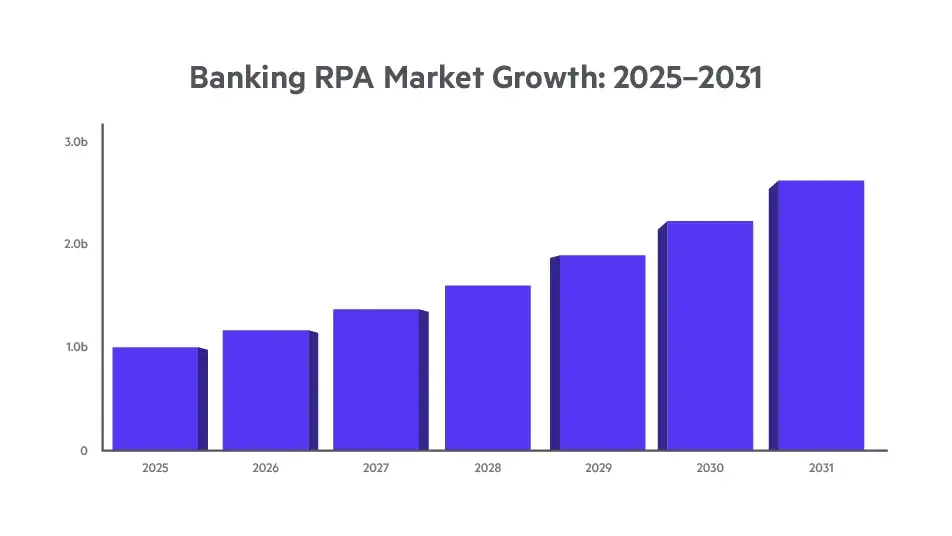
The market size of RPA in the banking sector was valued at USD 842.7 million in 2022, whereas it’s projected to reach USD 4,044.1 million by 2033. However, many banks continue to face challenges in scaling RPA solutions, primarily due to the complexity of their business processes and technical limitations.

Banking Processes Behave Differently across Branches

There are multiple RPA use cases in banking, such as account opening, loan servicing, and dispute handling. However, regional compliance rules, legacy system constraints, and branch-level workarounds often cause banking processes to vary in ways that only become apparent once automation is underway.

This variability can cause bots to fail in specific branches, resulting in inconsistent outcomes across regions. From an automation perspective, these inconsistencies create room for errors, rework, and delays, reducing the expected efficiency gains. Identifying and accounting for branch-level process behavior early becomes essential to building scalable and reliable RPA solutions in banking environments.

EvonSys addresses this challenge through deep process discovery that goes beyond documented workflows. We analyze the execution patterns across regions, systems, and teams, enabling banks to build RPA solutions that remain stable and scalable across the enterprise.

Technical Complexity from Legacy and Fragmented Systems

Banks run on a combination of legacy core platforms, custom-built applications, third-party tools, and modern digital systems that were never built for automation. UI changes, patch releases, and system upgrades frequently break bots. At the same time, different business branches often use different versions of the same applications, increasing bot maintenance effort.

This fragmentation leads to repeated production failures and increasing support costs. Teams focus on stabilizing existing bots, and technical complexity remains a core driver of the key challenges in scaling RPA solutions, directly limiting ROI and long-term impact.

EvonSys designs the RPA architecture that accounts for the behavior and change frequency of legacy systems. We apply reusable components, resilient bot design, and governance frameworks that reduce breakages and maintenance effort. This enables banks to scale RPA programs with confidence rather than constantly reacting to system changes.

Conclusion

The Bottom Line

Manual work remains one of the most underestimated cost drivers in banking operations. While business operations may appear structured, execution still depends on repetitive, rule-based tasks spread across fragmented systems. This gap between process design and day-to-day execution is exactly where many RPA use cases in banking deliver the most value. When applied with the proper process insight, technical resilience, and governance, RPA moves beyond task automation.

EvonSys helps banks realize this shift by combining deep banking domain expertise with proven RPA delivery frameworks. We focus on how processes actually run across branches and systems, design resilient automations for legacy environments, and apply governance models that support long-term scale.

Ready to transform your operations?

Understand where RPA can deliver the fastest value in your banking operations.

Related Articles

From AI Assistants to AI Ecosystems: Understanding Google’s A2A Protocol

Read More
Mar 17, 2026

The Role of Visual Application Development in Scalable Low-Code Modernization

Read More
Mar 3, 2026

Capture Business Opportunities with the Right Digital Transformation Strategy

Read More
Feb 20, 2026