Evonsys is propelling industries into the future, transforming operations and customer experiences with low-code solutions that unlock unprecedented levels of efficiency and innovation.
Since 2015, Evonsys has harnessed the power of low code to refine global organizations. We've revolutionized sectors from banking to retail with our comprehensive solutions, focusing on risk mitigation, management optimization, and streamlined automation for unrivaled efficiency.
The True Cost of Legacy Code: Why Low-Code Modernization Is Critical for Pension System Solvency
The True Cost of Legacy Code: Why Low-Code Modernization Is Critical for Pension System Solvency
December 22, 2025
HIGHLIGHTS
ON THIS PAGE
Outdated Systems Are a Real Threat to Pension Fund Stability
A hidden crisis threatens America's pension systems—and it has nothing to do with the stock market.
In public retirement systems, financial risk is often framed around investment markets, contribution rates, or actuarial assumptions. Yet an equally urgent and often overlooked threat lies within: the fragility of legacy IT systems.
Across the United States, pension funds operate on technology platforms built one, two, or even three decades ago. These aging systems—propped up by patches, manual workarounds, and institutional knowledge—pose operational bottlenecks, escalating costs, and security vulnerabilities that jeopardize both efficiency and member trust.
A 2025 report by the U.S. Government Accountability Office (GAO) underscores the severity of this problem, warning that legacy systems across federal and state agencies are "increasingly unable to support the missions of modern government services," creating both operational and cybersecurity vulnerabilities. For agencies managing billions of dollars in assets and millions of member records, the risk is far from theoretical.
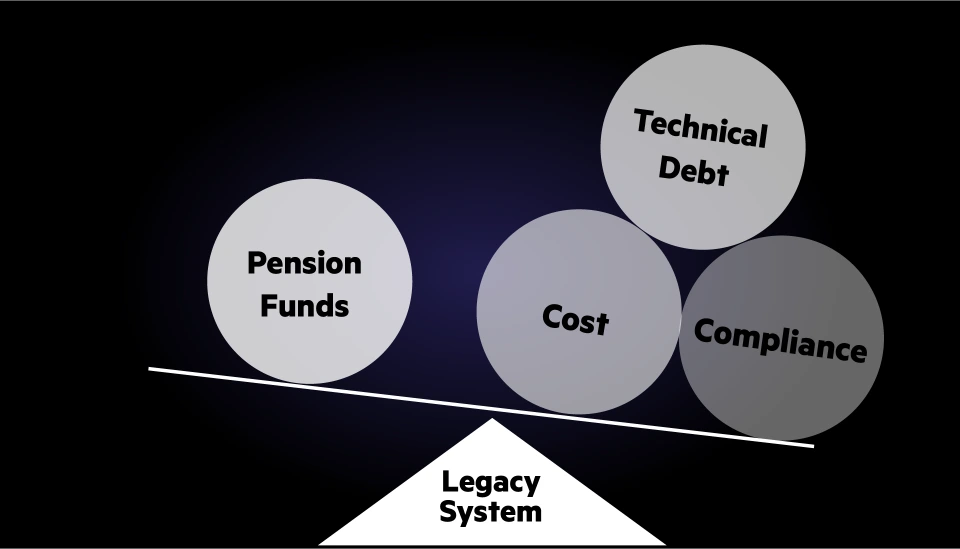
The Compounding Crisis of Technical Debt
Technical debt in pension administration is no longer abstract—it directly affects budgets, operational performance, and long-term solvency .
Rising Operational Costs
Maintaining legacy systems requires rare skill sets, such as COBOL or PowerBuilder, which continue to shrink in availability. Pension funds often face:
Higher rates for specialized contractors
Longer turnaround times for minor system changes
Increased downtime as aging components fail
The talent pool maintaining these systems is literally retiring faster than it can be replaced, creating a knowledge gap that threatens operational continuity.
Regulatory and Policy Risk
Responding to new benefit tiers, legislative mandates, or IRS regulations is slower and more expensive on legacy platforms. Manual spreadsheets and workarounds introduce errors and amplify audit exposure.
When legislative changes require system updates, pension administrators operating on decades-old platforms face months-long implementation cycles—during which manual processes create compliance risks and member service delays.
Member Experience Gaps
Modern retirees expect intuitive, mobile-friendly digital services. Delays in benefit calculations, inaccessible portals, and multi-week processing times erode trust and drive up inbound inquiries.
Today's retirees—many of whom manage their entire financial lives on smartphones—are confronted with pension systems that can't display properly on mobile devices, require paper forms, or take weeks to process routine requests. This gap between expectation and reality undermines confidence in the very institutions managing their retirement security.
Escalating Security Risk
Older systems are harder to patch, monitor, or integrate with modern security architectures, leaving sensitive member data exposed. GAO findings confirm that legacy-heavy agencies are disproportionately vulnerable to cyber incidents.
The same systems that are difficult to update for new features are nearly impossible to secure against evolving cyber threats, creating an attractive target for malicious actors seeking access to personal financial information.
The False Economy of Waiting vs. the Risk of a Misstep
Pension leaders often hesitate to modernize due to cost, complexity, or perceived risk. Yet inaction carries its own substantial dangers.
The Cost of Waiting
Every year of delay increases maintenance costs, integration complexity, security exposure, and reputational risk. What might have been a manageable upgrade can evolve into a multi-month, high-cost emergency project.
The financial mathematics are stark: maintenance costs for legacy systems typically increase 15-20% annually, while the risk of catastrophic failure—whether through security breach, system collapse, or regulatory non-compliance—grows exponentially.
The Cost of a Misstep
Yet rushing into modernization without the right approach carries equal danger. Attempting a traditional, full rewrite can result in:
Multi-year delays
Budget overruns reaching 200-300% of original estimates
Unmaintainable custom code that creates new technical debt
Solutions that fail to meet business or member needs
For pension systems, a failed modernization can create operational paralysis, leaving administrators unable to process benefits, respond to member inquiries, or adapt to regulatory changes—a crisis that directly threatens fund solvency and member trust.
The challenge, then, is finding a modernization path that avoids both the mounting costs of inaction and the catastrophic risks of a failed transformation.
A Proven Path: Low-Code Modernization
A well-known pension client which EvonSys has worked with for over five years faced these exact challenges. Rather than opting for a risky custom rebuild or piecemeal patches, they adopted a leading low-code platform to accelerate modernization while minimizing disruption.
Key Outcomes Included:
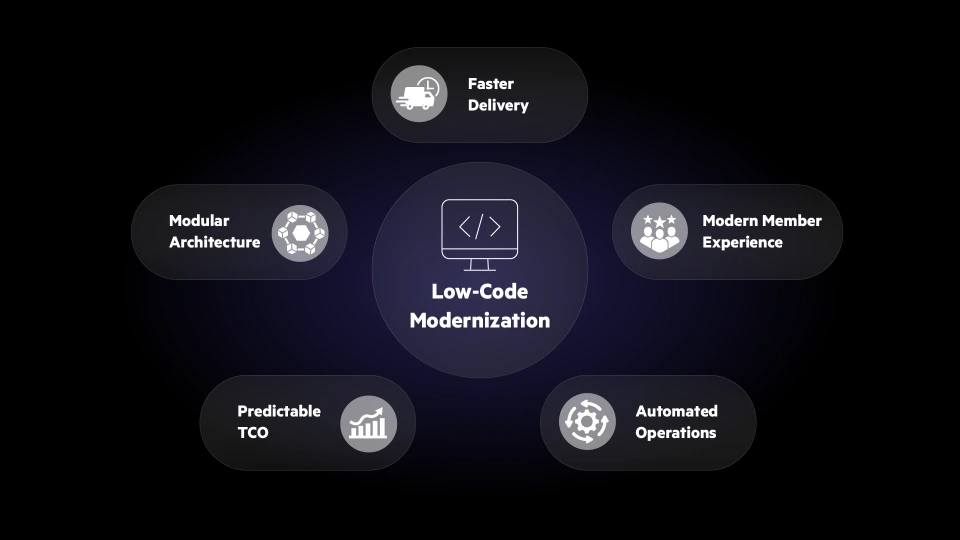
1. Accelerated Delivery
Low-code's reusable components and visual development reduced project timelines from years to months, providing rapid, measurable results. What would have required a five-year custom development cycle was completed in phases over 18 months, with each phase delivering immediate operational value.
2. Architecture Designed for Change
A modular design, API-driven integrations, and cloud-native scalability replaced brittle monolithic systems, enabling rapid adaptation to new requirements. When new legislation required benefit calculation changes, updates that previously took months could be implemented in weeks.
3. Predictable Total Cost of Ownership
Configuration over custom code reduced long-term maintenance overhead and provided predictable budgets for future enhancements. Annual maintenance costs dropped by 40% compared to legacy system support, freeing resources for member-facing improvements.
4. Automated, Streamlined Operations
Intelligent workflow automation and policy-driven decisioning optimized processes such as benefit calculations, employer reporting, audits, and member communications. Processes that previously required manual intervention and multi-week cycles became automated, reducing errors and processing time by 65%.
5. A Modern Member Experience
Secure, user-friendly self-service features increased transparency, reduced inbound call volume, and improved overall satisfaction—critical metrics for any CTO or CIO overseeing digital transformation. Member portal adoption increased by 73%, while call center volume dropped by 45%, representing substantial operational savings.
Industry Trends Reinforce the Urgency
Multiple industry studies indicate that modernization is a strategic imperative:
Agencies with legacy systems incur 30-50% higher operational and security costs
Cloud-native, low-code architectures reduce risk and improve speed and scalability by 3-5x
For CIOs and CTOs, these trends highlight that modernization is not just an IT initiative—it is a strategic investment in operational resilience and fiscal responsibility.
The evidence is overwhelming: organizations that defer modernization face a compounding disadvantage in operational efficiency, security posture, and member service quality. Meanwhile, those that embrace low-code and cloud-native approaches are positioning themselves for long-term sustainability.
Why Low-Code + Cloud Is the Future
Low-code platforms allow agencies to rapidly build robust applications with minimal custom code, enabling faster development cycles, easier maintenance, and better alignment with business needs.
Rather than writing hundreds of thousands of lines of custom code—which must then be maintained, updated, and debugged for decades—low-code platforms provide pre-built, configurable components that dramatically accelerate development while reducing long-term technical debt.
Paired with cloud infrastructure (such as AWS), agencies gain scalable compute and storage, enhanced security, high availability, and improved disaster recovery capabilities. Cloud platforms provide enterprise-grade security, automatic updates, and infrastructure that scales with demand—capabilities that are prohibitively expensive to build and maintain with on-premises systems.
Together, these technologies provide a blueprint for long-term operational resilience and flexibility. They represent a fundamental shift from custom-built, maintenance-intensive solutions to configurable, cloud-native platforms that adapt to changing requirements without requiring complete rebuilds.
Building Digital Resilience: A Path Forward
Legacy systems are a growing liability for pension systems, but the path to modernization doesn't have to be risky or disruptive.
EvonSys, as a trusted Global Elite Pega partner with extensive experience in cloud migrations and modernization for both public-sector clients and leading banks, offers a low-risk path to modernization. Leveraging low-code platforms and cloud architectures, we help pension administrators:
Reduce technical debt through configurable platforms
Improve operational efficiency with automated workflows
Enhance member experience through modern, mobile-friendly interfaces
Maintain regulatory compliance with adaptable systems architecture
The question facing pension system leaders is no longer whether to modernize, but how to do so in a way that minimizes risk while maximizing operational and financial returns.
If your retirement system is facing similar challenges—rising maintenance costs, security vulnerabilities, member experience gaps, or regulatory adaptation challenges—schedule a consultation with EvonSys to explore a tailored modernization roadmap that delivers results with minimal disruption.
The cost of waiting grows with each passing year. The cost of a failed modernization attempt can be catastrophic. But the right approach—low-code, cloud-native, and phased—offers a proven path to operational resilience and long-term solvency.
References
U.S. Government Accountability Office. Information Technology: Agencies Need to Plan for Modernizing Critical Decades-Old Legacy Systems (GAO-25-107795), July 2025. https://www.gao.gov/products/gao-25-107795



































.png)

.png)



.png)


.png)


