Evonsys is propelling industries into the future, transforming operations and customer experiences with low-code solutions that unlock unprecedented levels of efficiency and innovation.
Since 2015, Evonsys has harnessed the power of low code to refine global organizations. We've revolutionized sectors from banking to retail with our comprehensive solutions, focusing on risk mitigation, management optimization, and streamlined automation for unrivaled efficiency.
Choosing the Right E&I Approach: What Banks Should Consider
Choosing the Right E&I Approach: What Banks Should Consider
November 14, 2025
HIGHLIGHTS
ON THIS PAGE
As global payments turn towards ISO 20022, banks are facing a crucial question - how can they modernize their payment exceptions and investigations processes to stay compliant, efficient, and customer-focused?
The shift from legacy MT messages to ISO 20022 MX messages isn’t just a technical migration; it will completely transform the way banks are operating. This move will define how banks thrive in an increasingly fast-paced and data-driven payment landscape. This is emphasized still further in the context of cross-border payments, where Swift Case Orchestrator provides the potential for better, faster, cheaper investigations.
Why Do Modernization Matters?
CBPR+ is a cross-border version of ISO 20022 that provides structured messaging for cash management and investigations across the SWIFT network for cross-border payments. The expected transition from MT to MX will happen between 2025 and 2027, with the first significant E&I compliance milestone planned for November 2026.
That said, many banks are still in the early stages of planning. Delaying too long to start migrating can cause a last-minute rush to meet compliance checkboxes and might lead to higher costs, technical debt, and operational risk.
On top of that, domestic payment E&I messages are also adopting ISO 20022, with varying rules and timelines.
In the U.S., FedWire is migrating to ISO 20022, FedNow was built on ISO 20022 natively, and RTP supports richer ISO 20022 messages.
In the U.K., Faster Payments, CHAPS and RTGS have transitioned to ISO 20022, with enhanced data rules planned from 2027.
In Europe, T2 (replacing TARGET2) and SEPA operate fully on ISO 20022, each following their own timelines and structures.
For banks operating across multiple countries and systems, modernization encompasses more than SWIFT's CBPR+ and must expand to the entire remit of cross-border and domestic standards.
How Banks Are Approaching Payment Exceptions and Investigations Modernization
Every bank’s modernization journey looks a little different. But most are taking one of three main paths. Let’s look at what each one offers and what challenges come with it
1. Building In-House Solutions
Some banks prefer to build in-house E&I tools. This approach typically involves complete customization, including their workflows, interfaces, and automation to match internal processes. However, it requires significant resources. Internal builds will also require:
Skilled development teams familiar with ISO 20022 data structures and the Swift Case Orchestrator business rulebook
Regular updates to match annual SWIFT and domestic compliance releases
Continuous alignment with compliance and audit requirements
Additionally, in-house built tools tend to have longer delivery timelines and higher long-term TCO (Total Cost of Ownership)
2. Extending Existing Core Payment Systems
Another common approach is enhancing existing platforms by adding any E&I modules or plugins into the existing payment landscape. At first, this can seem like a practical solution since teams already know the system, and the integration effort appears minimal. But here’s the catch — legacy platforms weren’t built for ISO 20022’s structured message formats.
Even if the platform is ISO 20022 ready, it might have sufficient capability for basic case routing, the limitations with the platform often show up in these areas:
Limited message validation across MT and MX formats
Weak case tracking and collaboration tools
Manual-heavy workflows that reduce speed and accuracy
Without automation, investigations end up being slower — undermining the purpose of modernization.
3. Adopting a Specialized E&I Automation Platform
A growing number of banks are turning to specialized E&I automation platforms designed from the ground up for ISO 20022. These platforms follow current payment processing trends. They also use advanced exception management software capabilities for end-to-end automation while integrating easily with core systems and payment gateways. This gives teams real-time visibility, faster case turnaround, and fewer manual handoffs.
Banks using modern payment exceptions and investigations platforms have reported:
Up to 70% faster case resolution
Reduced operational costs, thanks to automation
Fewer headaches associated with getting compliant and staying compliant with ISO20022 and Swift Case Orchestrator
Improved customer satisfaction
What to Consider Before Choosing an E&I Approach
Before committing to a modernization path, banks should evaluate a few critical factors:
1. Compliance and Standards Alignment
ISO 20022 will continue to evolve through upcoming SWIFT releases (SR2025, SR2026, SR2027 etc). At the same time, domestic systems will issue their own updates and rulebooks. Your E&I strategy should be flexible enough to handle continuous change, not just one-time migration.
2. Depth of Automation
ISO 20022 messages are rich in structured data — great for automation but complex for manual handling. Automation helps interpret fields, route cases, and reduce human errors. Without it, investigations can slow down resolution activity and add operational risk.
3. Integration and Interoperability
Your E&I system must connect smoothly with core banking platforms, payment gateways, and correspondent networks. This ensures every case is visible and traceable regardless of the payment type or geography.
4. Transparency and Audit Readiness
A modern E&I platform should offer end-to-end traceability of every message, action, and decision from initiation to closure. This transparency enables both operations and compliance teams to easily reconstruct the investigation trail during audits or regulatory reviews. Integrated case timelines, user logs, and message lineage give teams complete visibility. This unified view simplifies audits, ensures compliance, and builds confidence with regulators and partners as well.
5. Scalability and Cost
As transaction volumes rise, your E&I system should scale seamlessly. A good E&I system offers on-demand capacity, modular deployment, and integration with existing payment systems while helping banks handle huge volumes of investigations without large upfront costs.
6. Customer Experience
Customers expect instant payments and at the same time, they expect instant resolutions for any investigation request which they raise. Modern exception management software enables faster updates, self-service case creation, and quicker resolution. Delivering faster, transparent, and proactive responses directly improves customer satisfaction and strengthens brand trust.
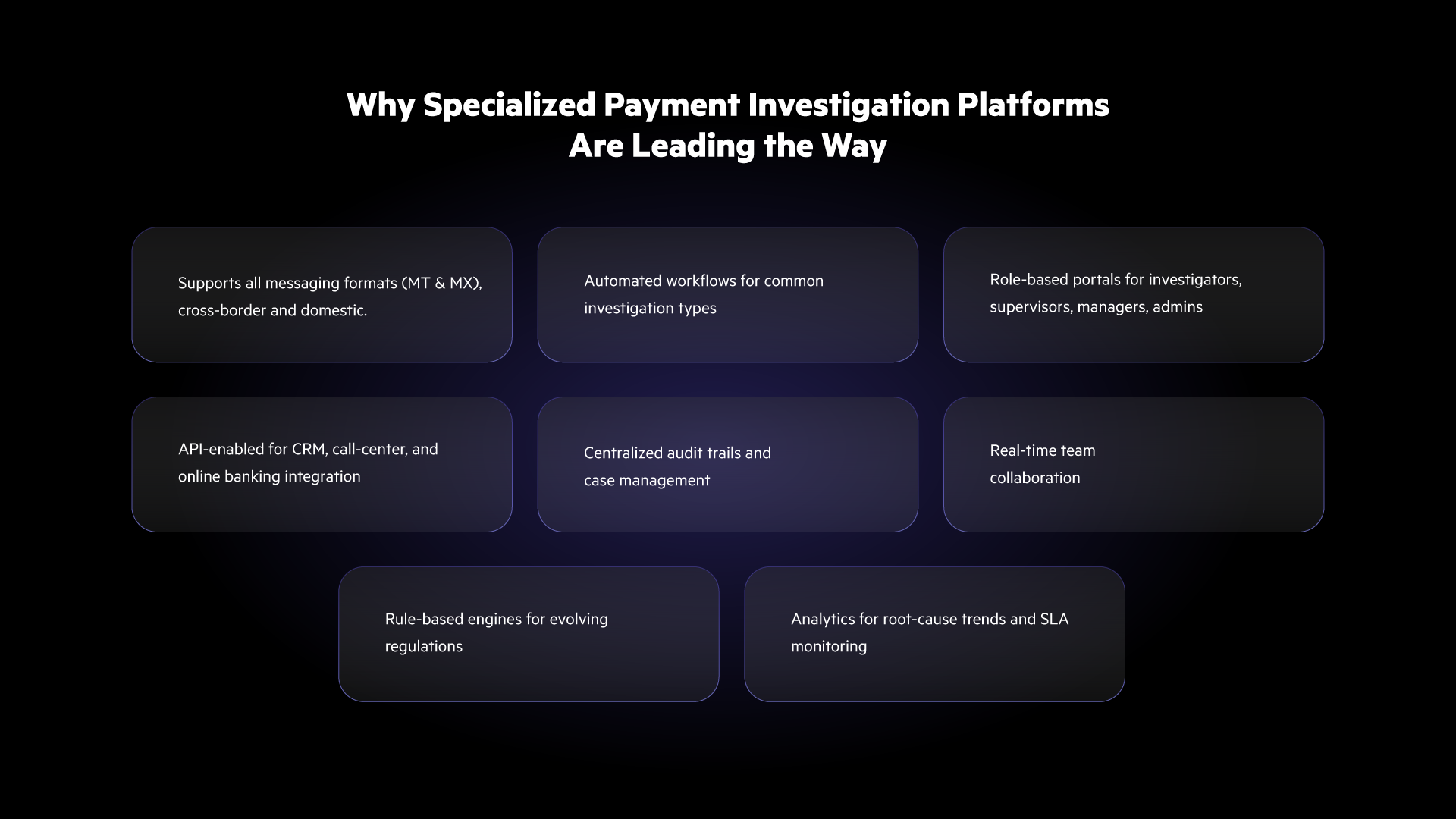
Why Specialized Payment Investigation Platforms Are Leading the Way
Specialized E&I automation platforms are gaining traction because they’re built for the ISO 20022 & Swift-ready cross-border payment investigations. They also help banks to stay ahead of payment processing trends while giving access to everything in a single and unified platform:
Support for all messaging formats, both cross-border and domestic, both on day 1 and in future as standards and formats evolve
Automated business processes for the most common investigation types
Role-based portals for investigators, supervisors, managers and admins
API-enabled, to allow external tools such as CRM, call-center or internet banking to create investigations
Centralized audit trails and case management
Real-time collaboration across all the teams
Rule-based engines that adapt to evolving regulations
Analytics for root-cause trends and SLA monitoring
By integrating these capabilities, banks can accelerate case resolution and enable smarter decision-making across the entire payments ecosystem. This approach turns investigation data into actionable insights that drive operational efficiency, strengthen regulatory compliance, and improve customer experience.
Final Thoughts
As banks navigate the ISO 20022 transition, modernizing payment investigations is less about catching up and more about staying ahead. By choosing an approach that combines automation, integration, and real-time insights, financial institutions can turn E&I into a source of agility. Also, it speeds up case resolution, reduces risk, and improves transparency while creating a payment investigation experience that inspires trust and confidence.

































.png)

.png)



.png)


.png)


