Evonsys is propelling industries into the future, transforming operations and customer experiences with low-code solutions that unlock unprecedented levels of efficiency and innovation.
Since 2015, Evonsys has harnessed the power of low code to refine global organizations. We've revolutionized sectors from banking to retail with our comprehensive solutions, focusing on risk mitigation, management optimization, and streamlined automation for unrivaled efficiency.
Mendix vs Pega: A Hands‑On Low‑Code Journey from a Developer’s Chair
Mendix vs Pega: A Hands‑On Low‑Code Journey from a Developer’s Chair
March 26, 2026
HIGHLIGHTS
This blog uncovers the fundamental philosophical divide between Mendix and Pega beyond features and explains why that difference shapes everything from UX design to enterprise governance.
Explore how each platform behaves under operational pressure, compliance scrutiny, and multi-team environments and why the wrong choice becomes visible only after deployment.
Instead of listing features, this guide provides a structured way to evaluate, prototype, and validate your platform choice before committing long-term investment.
Choosing between Mendix and Pega often begins as a technology discussion but quickly turns into a strategic decision. Both platforms promise speed, agility, and enterprise readiness. Yet the outcomes they produce can look very different depending on the nature of the problem, the maturity of the organization, and the expectations around governance, compliance, and user experience.
This article breaks down Mendix and Pega through a practical, enterprise lens. You will understand how they differ in platform philosophy, user experience control, case management depth, governance structure, integration flexibility, and scaling behavior. You will also see where hybrid models make sense, what common mistakes teams make during evaluation, and how to apply a structured decision framework before committing investment.
Rather than comparing features in isolation, this guide connects each platform’s strengths to real organizational contexts. The goal is clarity. When you align platform capabilities with business priorities, the right direction becomes evident.
Before diving into feature-level differences, it is essential to understand the core philosophy that drives each platform’s design. That foundation shapes every downstream capability.
Low‑Code DNA: The Common Ground
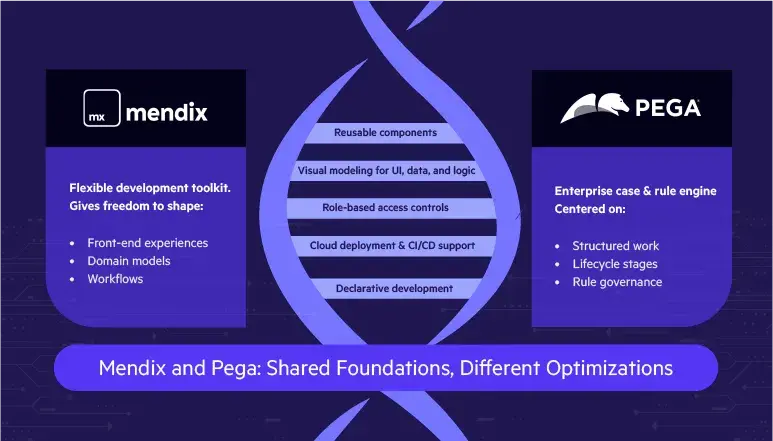
Mendix and Pega share a strong foundational similarity. Both are model-driven low-code platforms designed to reduce hand-coding effort and accelerate enterprise delivery.
At their core, both platforms provide:
Visual modelling for user interfaces, data structures, and business logic
Reusable components and marketplace ecosystems
Role-based access controls
Cloud deployment and CI/CD support
Declarative development approaches that reduce boilerplate engineering
However, similar foundations do not imply identical intent.
Mendix operates as a flexible application development toolkit. It empowers teams to shape front-end experiences, domain models, and workflows with significant freedom.
Pega operates as an enterprise case and rule engine. Its modelling approach centers around structured work, lifecycle stages, and rule governance.
Both accelerate delivery. The difference lies in what they are optimized to accelerate.
UX Control vs Consistency
UI & Experience: Craft vs Consistency
User experience often becomes the visible differentiator in digital transformation initiatives. This is where Mendix and Pega diverge clearly in design philosophy.
Mendix: High Degree of UI Control
Mendix provides fine-grained control over user interfaces. Development teams can:
Customize layouts extensively
Extend functionality through pluggable widgets
Create differentiated, brand-aligned interfaces
Iterate rapidly on customer-facing applications
This flexibility makes Mendix effective for digital portals, partner ecosystems, and product-style applications where visual differentiation influences adoption and engagement.
Pega: Structured and Consistent Enterprise UX
Pega emphasizes consistency and maintainability. Its design system, including Cosmos, enables:
Rapid screen generation
Standardized user interfaces
Reduced UI-level customization risk
Easier long-term maintenance across large teams
This approach benefits enterprises where predictability, governance, and deployment speed outweigh aesthetic differentiation.
In environments with multiple teams contributing to the same system, standardization reduces fragmentation and technical debt.
Case & Rule Depth
Process, Rules, and Case Management: Where Pega Dominates
Process depth determines how your system behaves under operational stress, regulatory scrutiny, and scale.
Pega: Native Case Lifecycle Management
Pega is architected around case management. It offers:
Built-in case types with defined stages and steps
SLA configuration and escalation handling
Dynamic routing based on business rules
Integrated decision tables and rule layering
End-to-end audit traceability
For applications driven by approvals, compliance checkpoints, escalations, and multi-actor workflows, Pega reduces the need for custom engineering. The orchestration layer is native rather than constructed.
Mendix: Flexible but Custom-Oriented Process Modeling
Mendix uses microflows and logic modeling to define workflows. This provides flexibility and works well for:
Moderate workflow complexity
Interaction-heavy applications
Product-centric use cases
However, complex lifecycle management requires deliberate architectural design. Developers must model case-like behavior rather than relying on a built-in case engine. For straightforward process needs, this flexibility is sufficient. For deeply layered workflows with SLAs and audit sensitivity, architectural overhead increases.
Decision Hint
If your domain is defined by compliance controls, SLA enforcement, and dynamic routing logic, Pega aligns naturally with that requirement. If your application is interaction-driven, product-focused, and less dependent on strict lifecycle governance, Mendix offers greater agility.
Data & Integration Model
Data & Domain Modeling
Data architecture shapes how an application evolves. The way a platform models entities, relationships, and state transitions influences performance, integration complexity, and governance behavior.
Mendix
Mendix uses traditional domain modeling with clear entity relationships. Data structures are easy to expose to UI layers and external systems. This works well for:
Data-centric applications
Customer portals
Dashboard-driven systems
When relationships between entities drive the application, Mendix offers flexibility and clarity.
Pega
Pega ties data closely to case types and workflow stages. Data visibility and state changes are influenced by process progression. This model suits:
Workflow-heavy systems
Compliance-driven applications
State-based lifecycle management
When process events control how data evolves, Pega aligns naturally.
Strategic Filter
If your system revolves around structured data relationships, Mendix fits well.
If your system revolves around controlled state transitions and process milestones, Pega is stronger.
It works well for greenfield builds and API-driven ecosystems where speed and flexibility matter.
Pega: Orchestration at Scale
Pega offers:
REST and SOAP connectors
Data pages for integration abstraction
Built-in decisioning and automation hooks
It fits complex enterprise environments where multiple systems must be orchestrated under structured governance.
Practical Perspective
For UX-driven, API-first applications, Mendix is light and quick. For heavy back‑office orchestration, Pega fits naturally.
Governance & Scale
Performance & Observability
Performance optimization depends on what drives system load.
Mendix: UI and Client Performance
Mendix offers:
Studio Pro profiling tools
Client-side optimization through nanoflows
Performance tuning often focuses on UI responsiveness and concurrent user behavior.
Pega: Operational Monitoring
Pega provides:
Tracer and PAL/PLA tools
SLA monitoring
Queue processors for workload management
Optimization typically centers on case throughput and process efficiency.
Practical Guidance
If user concurrency and front-end responsiveness dominate, focus on Mendix performance tuning.
If long-running workflows and case volumes drive load, evaluate Pega’s throughput and monitoring capabilities carefully.
Security & Compliance
Both Mendix and Pega support:
Role-based access control
Single sign-on
Audit logging
The difference lies in depth.
Mendix
It offers clear entity-level security controls. It suits customer-facing and moderately regulated applications where protection is required but lifecycle audit depth is limited.
Pega
Pega embeds auditability within its case framework. Case history, rule tracking, and SLA visibility make it strong in compliance-heavy environments.
Strategic View
For moderate risk environments, Mendix is sufficient and straightforward.
For strict regulatory and audit-driven domains, Pega provides stronger built-in governance.
Team Structure & Cost Dynamics
Platform choice also affects team composition and long-term cost structure.
Mendix teams are often:
Smaller
Cross-functional
Product-oriented
This setup supports rapid product builds and shorter ramp-up cycles. It can reduce initial overhead for innovation-driven initiatives.
Pega Environments Typically Include:
System architects
Business architects
Rule specialists
The learning curve is steeper, but the structured role model strengthens governance in complex enterprise systems.
Implementation Risks: Where Programs Go Wrong
Platform choice alone does not guarantee success. Execution discipline does. Common failure patterns include:
Over-customization
Excessive UI modification in Pega breaks standardization.
Rebuilding complex case logic in Mendix increases architectural overhead.
Delayed DevOps planning
Low-code still requires structured pipelines and environment governance from the start.
Late performance testing
Profiling must begin early, not before go-live.
When a Hybrid Strategy Makes Sense
A structured hybrid model can work when responsibilities are clearly divided:
Mendix handles user experience and front-end agility
Pega manages case lifecycle, rules, and orchestration
An event-driven approach, where Pega emits lifecycle events and Mendix consumes them, enables real-time interfaces without duplicating logic. Hybrid only makes sense when both experience differentiation and strict process governance are equally critical.
Decision & Validation Framework
Executive Heuristics
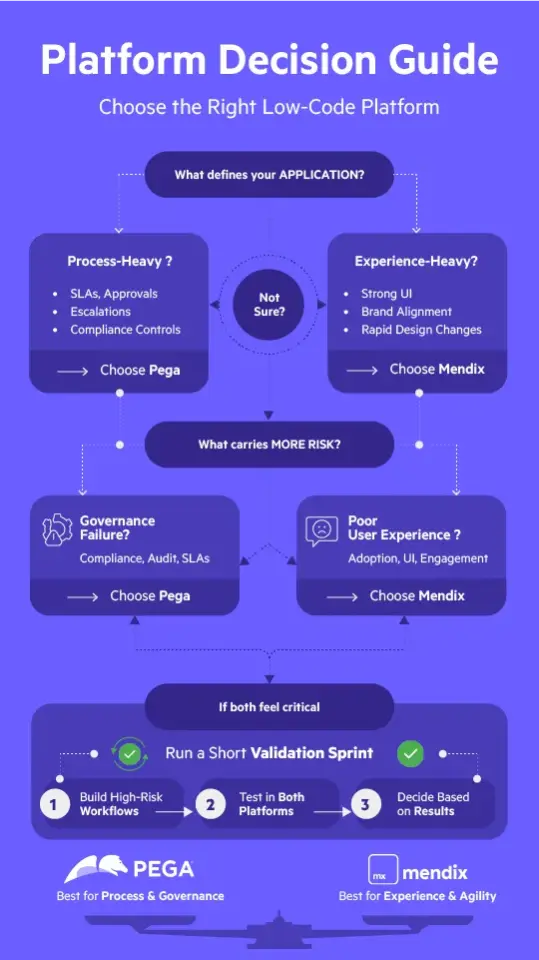
Some signals simplify the choice:
Operations-led transformation → Lean Pega
Customer or brand-led transformation → Lean Mendix
Compliance dominates discussion → Pega
Design dominates discussion → Mendix
If priorities compete, prototype instead of debating.
Developer Checklist Before You Pick
Clarify: Experience‑led or process‑led?
Map: Entities, stages, SLAs, and interactions
Score: Governance need, UI flexibility, integration complexity
Decide: Mendix, Pega, or spike both
Plan: CI/CD, security, observability from day one
7-Day Validation Framework
Day 0: Pick the riskiest story and success criteria.
Day 1: Create app skeleton and a basic form/case template.
Day 2: Build the main UI or case flow.
Day 3: Add a mock integration (REST) and test end‑to‑end.
Day 4: Implement the trickiest rule (discount, SLA, routing).
Day 5: Demo to one stakeholder and collect feedback.
Day 6: Fix top feedback items and profile.
Day 7: Decide go/no‑go and document next sprint.
Moving from Evaluation to Delivery
For enterprises navigating Mendix, Pega, or hybrid architectures, structured guidance during early design phases prevents costly rework later. The priority is clarity before commitment.
Pick the platform that fits the problem, not the one you like best. Then build the riskiest thing first and learn fast.
EvonSys works across Mendix, OutSystems, and Pega environments, supporting architecture design, implementation strategy, and the transition from prototype to production-ready systems. The focus remains practical execution, grounded in business alignment rather than platform bias.
Still Evaluating Mendix or Pega?
Make the right platform choice. EvonSys helps you design and scale governed low-code architectures.

































.png)

.png)



.png)


.png)


